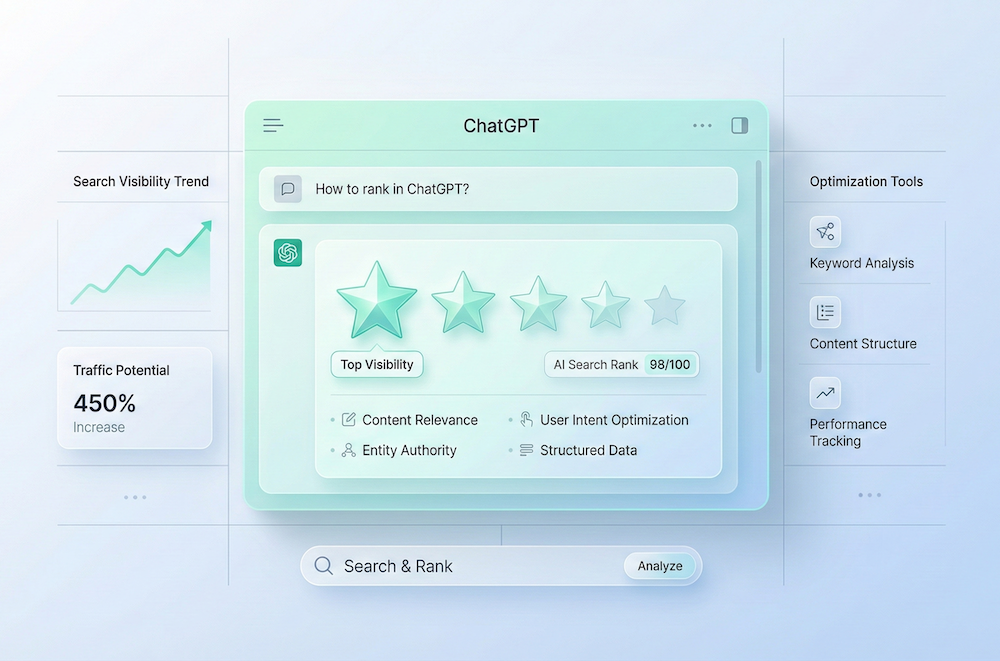
How to Rank in ChatGPT: The Ultimate Guide to AI Search Visibility
Want your brand mentioned in ChatGPT responses? Learn how to rank in AI search using Opttab's AXP platform, JSON-LD strategies, and 10x faster indexing techniques.
Table of Contents
- Introduction: The New Gatekeeper of Information
- Deconstruct the Algorithm: How ChatGPT "Searches"
- The 4 Pillars of Ranking in LLMs
- The Secret Weapon: Advanced JSON-LD
- How Opttab's AXP Delivers 10x Faster Indexing
- Step-by-Step: Optimizing Your Digital Footprint
- Beyond the Click: Measuring Citation Success
- Frequently Asked Questions
- Conclusion
For decades, the goal of digital marketing was simple: appear on the first page of Google. If you could secure a spot in the top ten blue links, you secured traffic. But the digital landscape has fundamentally shifted. Today, millions of users are bypassing traditional search engines entirely. They are asking questions directly to AI models like ChatGPT.
When a user asks ChatGPT, "What is the best project management software for remote teams?" or "How do I fix error code 503?", the AI generates a single, synthesized answer. If your brand is not part of that answer, you are invisible. You don't just lose a click; you lose the opportunity to be part of the conversation.
This guide explores the mechanics of Generative Engine Optimization (GEO) specifically for ChatGPT. We will look at how to move from being indexed by Google to being cited by AI, utilizing the power of Opttab's Agent Experience Platform (AXP).
Deconstruct the Algorithm: How ChatGPT "Searches"
To rank in ChatGPT, you must first understand that it is not a search engine in the traditional sense. It does not maintain a database of links to rank based on backlinks. Instead, it uses a process called Retrieval-Augmented Generation (RAG).
When a query requires current information, ChatGPT acts as an autonomous agent. It performs the following loop:
- Understand Intent: It parses the semantic meaning of the user's prompt.
- Browse (Retrieve): It sends a crawler (like OAI-SearchBot) to scan trusted, high-authority sources on the live web.
- Synthesize: It reads the content, extracts the relevant facts, and weaves them into a natural language response.
- Cite: It references the sources that provided the most accurate data chunks.
The Takeaway: You are not optimizing for a keyword match. You are optimizing to be the most readable, authoritative "Data Chunk" that the AI can find and understand instantly.
The 4 Pillars of Ranking in LLMs
What makes ChatGPT choose one source over another? It comes down to four core pillars:
1. Entity Establishment
ChatGPT thinks in "Entities" (concepts, brands, people), not strings of text. Your content must clearly define who you are and what you offer. Vague marketing copy confuses the AI. Clear, declarative statements establish your entity.
2. Information Density
AI models have a "token limit." They prefer content that is dense with facts and low on fluff. A 5,000-word article with 2% useful data will be ignored in favor of a 500-word article that is 90% useful data.
3. Structural Clarity
The AI needs to parse your content programmatically. It looks for logical hierarchies (H1, H2, H3), clear lists, and data tables. If your content is unstructured text, the AI struggles to extract the specific answer it needs.
4. Technical Accessibility
Can the bot read your site? Many modern websites are heavy with JavaScript that blocks AI crawlers. If ChatGPT's bot hits a wall of code it can't execute, it moves on to your competitor.
The Secret Weapon: Advanced JSON-LD
If clear text is good, JSON-LD (JavaScript Object Notation for Linked Data) is perfect. JSON-LD is code that sits in the background of your webpage and explicitly describes your content to machines.
For example, instead of hoping ChatGPT understands that "$99" is your price, you use JSON-LD to say:
"offers": {
  "@type": "Offer",
  "price": "99.00",
  "priceCurrency": "USD"
}
Why this matters: When ChatGPT retrieves data to answer a question like "How much does X cost?", it prioritizes sources where the data is structured and unambiguous. Implementing robust JSON-LD schema is the single most effective way to "speak the language" of AI.
How Opttab's AXP Delivers 10x Faster Indexing
Implementing these strategies manually is difficult and time-consuming. This is where Opttab's AXP (Agent Experience Platform) changes the game.
AXP creates a specialized layer of your website designed exclusively for AI agents. While your main site serves beautiful visuals to humans, the AXP layer serves ultra-lightweight, structured data to bots.
The Mechanics of Speed
Traditional crawling is slow because bots have to render heavy pages. Opttab's AXP strips away the "digital noise" (CSS, heavy scripts, images) and presents the AI with a pure stream of structured content. Because the payload is so small and easy to parse, indexing occurs up to 10x faster.
This means when you update a product or publish a blog, ChatGPT knows about it almost immediately, rather than waiting weeks for a re-crawl.
Step-by-Step: Optimizing Your Digital Footprint
- Audit Your Entity: Ask ChatGPT "Who is [Your Brand]?" If it hallucinates or says it doesn't know, you need to update your "About" page schema and establish your entity on knowledge bases.
- Deploy Opttab AXP: Install the Opttab plugin or API integration. This automatically generates the JSON-LD schema and lightweight AI layer for your site.
- Optimize for "Direct Answers": Identify the top questions in your niche. Rewrite your content to answer these questions directly in the first 50 words of your page (e.g., "The best software for X is Y because...").
- Establish `llms.txt`: Use Opttab to generate an `llms.txt` file. This acts as a roadmap for AI bots, guiding them to your most critical pages first.
Beyond the Click: Measuring Citation Success
In the world of AI search, "Click-Through Rate" is a secondary metric. The primary metric is Share of Voice.
You need to track how often your brand is cited as the source of truth. Opttab's analytics dashboard allows you to monitor your visibility across models. If you notice you are ranking well in GPT-4 but not in Claude, you can adjust your content strategy to align with the specific preferences of different models (e.g., Claude often prefers more long-form, reasoned context).
Frequently Asked Questions
Does ChatGPT use Google's index?
While ChatGPT can browse the web via Bing, it increasingly relies on its own direct crawling mechanisms and partnerships. Optimizing for Bing is helpful, but optimizing specifically for LLM readability via JSON-LD is more effective for direct citations.
Will AXP affect my site's design?
No. The AXP layer is invisible to human users. It is detected only by specific User Agents (bots) like OAI-SearchBot or GPTBot. Your human visitors continue to see your fully designed site.
Is JSON-LD difficult to implement?
Manually coding JSON-LD can be complex and error-prone. However, Opttab automates this process, dynamically generating the correct schema for your products, articles, and organization based on your existing content.
Conclusion
Ranking in ChatGPT is not about gaming an algorithm; it is about providing clarity to an intelligence. It requires a shift from keywords to entities, and from HTML to structured data.
By leveraging Opttab's AXP platform, you ensure that your content is not just visible, but understandable, citeable, and prioritized by the AI models that define the future of search.
Ready to get ranked in ChatGPT?
Stop being invisible to AI. Optimize your assets, generate advanced JSON-LD, and achieve 10x faster indexing with Opttab.