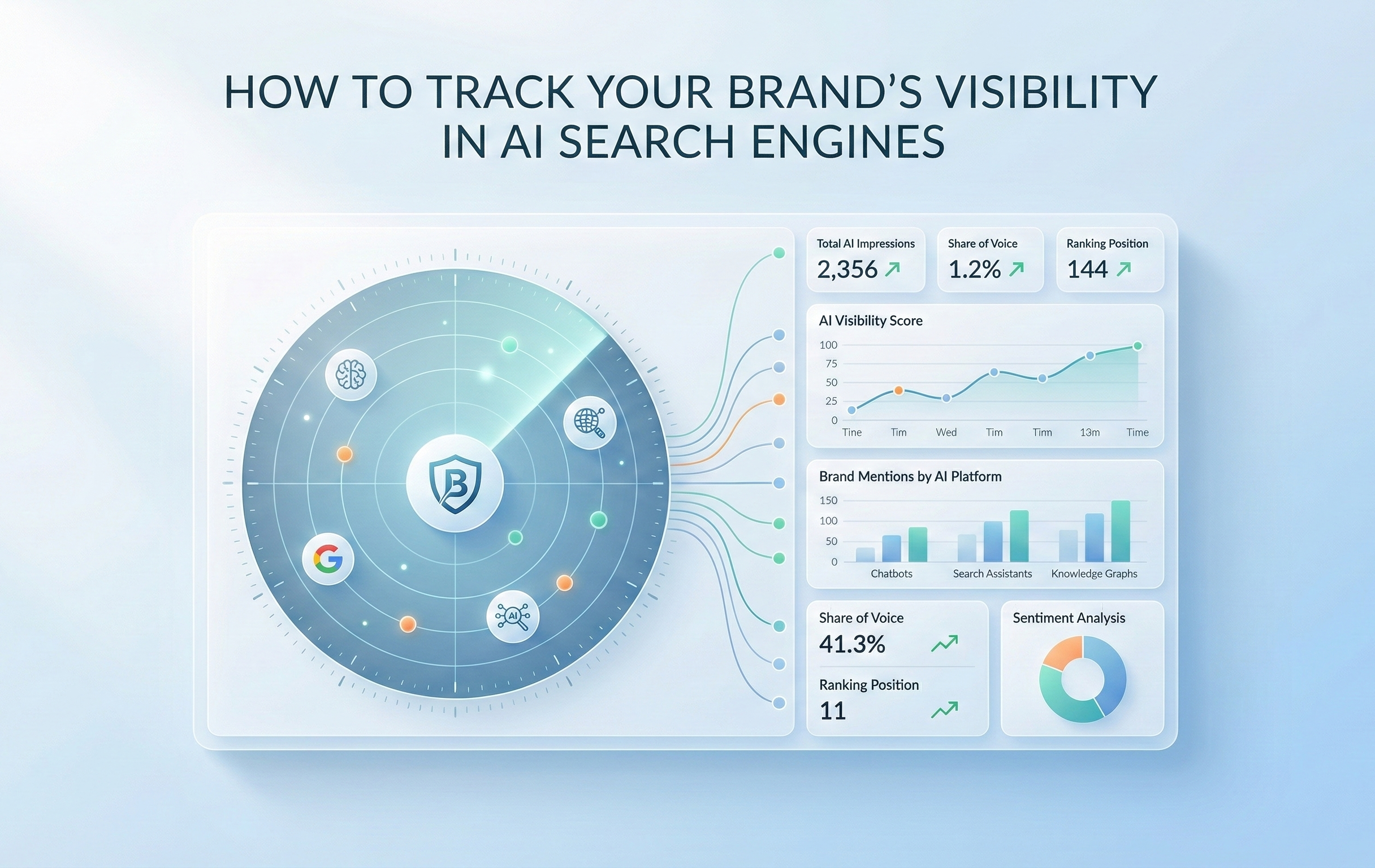
How to Track Your Brand's Visibility in AI Search Engines
For twenty years, digital marketers have relied on a comforting set of metrics: Rank, Click-Through Rate (CTR), and Page Views. If you ranked #1 on Google for your target keyword, you knew exactly what that meant for your bottom line.
But the rise of Generative AI has created a massive blind spot. Millions of users are now asking questions to ChatGPT, Claude, Perplexity, and Gemini. When these AI models answer, they don't provide a list of 10 blue links. They provide a single, synthesized response. Sometimes they mention your brand; sometimes they recommend your competitor; sometimes they hallucinate entirely.
The problem? Your traditional SEO tools cannot see this. They are scraping Google's SERP, not querying OpenAI's neural network. To survive in the AI era, you need a new way to measure success. You need to track AI Visibility. This guide explains how to do it using Opttab's advanced analytics suite.
Why Traditional SEO Tools Can't Track AI
SEO tools work deterministically. They search for a keyword, see where your URL sits on the page, and report the position. AI models work probabilistically. Every time you ask ChatGPT a question, the answer might vary slightly based on temperature settings, context windows, and updates to the training data.
Furthermore, there is no "Page 1" in AI. There is only the answer. You are either:
- The Primary Recommendation: The AI explicitly names your product as the best solution.
- A Citation: The AI uses your content to support its answer (often seen in Perplexity).
- Invisible: The AI does not know you exist or does not consider you relevant.
Tracking this requires a tool that can query multiple AI models repeatedly, analyze the text output, and quantify your presence. That tool is Opttab.
The New Metrics: Share of Voice & Sentiment
In the absence of rankings, what do we measure? Opttab introduces new KPIs for the AI age:
1. AI Share of Voice (SOV)
If a user asks "What are the top 5 CRMs?", does your brand appear in that list? If you appear in 8 out of 10 variations of that prompt, your AI Share of Voice is 80%. This is the closest equivalent to "Ranking" in the generative world.
2. Sentiment Score
Visibility isn't enough; context matters. Is the AI saying "Opttab is expensive and difficult to use" or "Opttab is the industry leader in asset protection"? Opttab uses natural language processing (NLP) to grade the sentiment of every brand mention, alerting you to reputation risks generated by AI hallucinations.
The Power of Multi-Model Scoring
A common mistake is optimizing only for ChatGPT. The AI landscape is fragmented. A developer might use Claude for coding questions; a researcher might use Perplexity; a consumer might use Gemini via their Android phone.
Opttab's Multi-Model Scoring tracks your brand across 7 major AI models simultaneously (including GPT-4, Claude 3, Gemini, Llama 3, and Mistral). This gives you a holistic view of your digital reality.
Example Scenario: You might discover via Opttab that you are the #1 recommendation on ChatGPT, but completely invisible on Gemini. This insight allows you to investigate why—perhaps Gemini favors Google's own index, requiring you to improve your traditional schema markup.
Query Rankings: Reverse Engineering the Prompt
In SEO, you track keywords. In AI Optimization, you track Query Rankings. These are the conversational prompts users are actually typing.
Opttab analyzes the semantic relationships between questions. Instead of just tracking "running shoes," we track:
- "Help me find running shoes for flat feet under $100."
- "Compare Nike vs. Adidas durability for marathons."
By monitoring these complex queries, you can identify the specific "Intent Buckets" where your brand is winning or losing. If you are losing on pricing queries, it might mean your pricing page isn't structured clearly enough for the AI to parse (using JSON-LD).
Trend Analysis: Spotting Shifts Before They Hurt
AI models update their weights and knowledge bases frequently. A new update from OpenAI can wipe out your visibility overnight, just like a Google Core Update.
Opttab's Trend Analysis visualizes your visibility score over time. It helps you correlate changes in visibility with your own actions (e.g., did publishing that whitepaper boost our citation rate?) or external events (e.g., did the release of GPT-5 drop our ranking?).
This feature transforms AI visibility from a guessing game into a predictable science.
Setting Up Your Opttab Dashboard
Here is how to start tracking today:
- Define Your Entity: Input your brand name and core products into Opttab. This tells the system what to look for.
- Select Your Competitors: Input 3-5 competitors. Opttab will track their visibility alongside yours, showing you exactly where they are stealing your AI market share.
- Choose Your Keywords/Queries: Upload your core SEO keywords. Opttab will convert these into conversational prompts to test against the AI models.
- Review the Report: Every week, you receive a breakdown showing which models love you, which ignore you, and actionable steps to improve via AXP.
Frequently Asked Questions
How accurate is AI visibility tracking?
Because AI is probabilistic, it is never 100% consistent. However, Opttab runs multiple simulations per query to provide a statistically significant "Confidence Score," giving you the most accurate picture possible of your likely visibility.
Can I track my visibility in specific regions?
Yes. AI models behave differently based on the user's location (IP). Opttab allows you to simulate queries from different global regions to check local visibility.
Why does Perplexity cite me but ChatGPT doesn't?
Perplexity is a "Live Answer Engine" that relies heavily on real-time web crawling (RAG). ChatGPT relies more on pre-trained internal knowledge. If you are winning on Perplexity but not ChatGPT, it likely means your content is fresh and structured (good for RAG), but your overall brand authority needs to be established in the model's long-term training data.
Conclusion
You cannot optimize what you do not measure. As the world shifts from Search Engines to Answer Engines, your analytics stack must evolve. Relying solely on Google Search Console is like driving a car using only the rear-view mirror.
By using Opttab to track Multi-Model Scoring, Query Rankings, and Trends, you gain the visibility needed to steer your brand through the AI revolution.
Are you invisible to AI?
Stop guessing. Start tracking your brand's visibility across GPT-4, Gemini, and Claude today with Opttab's analytics suite.