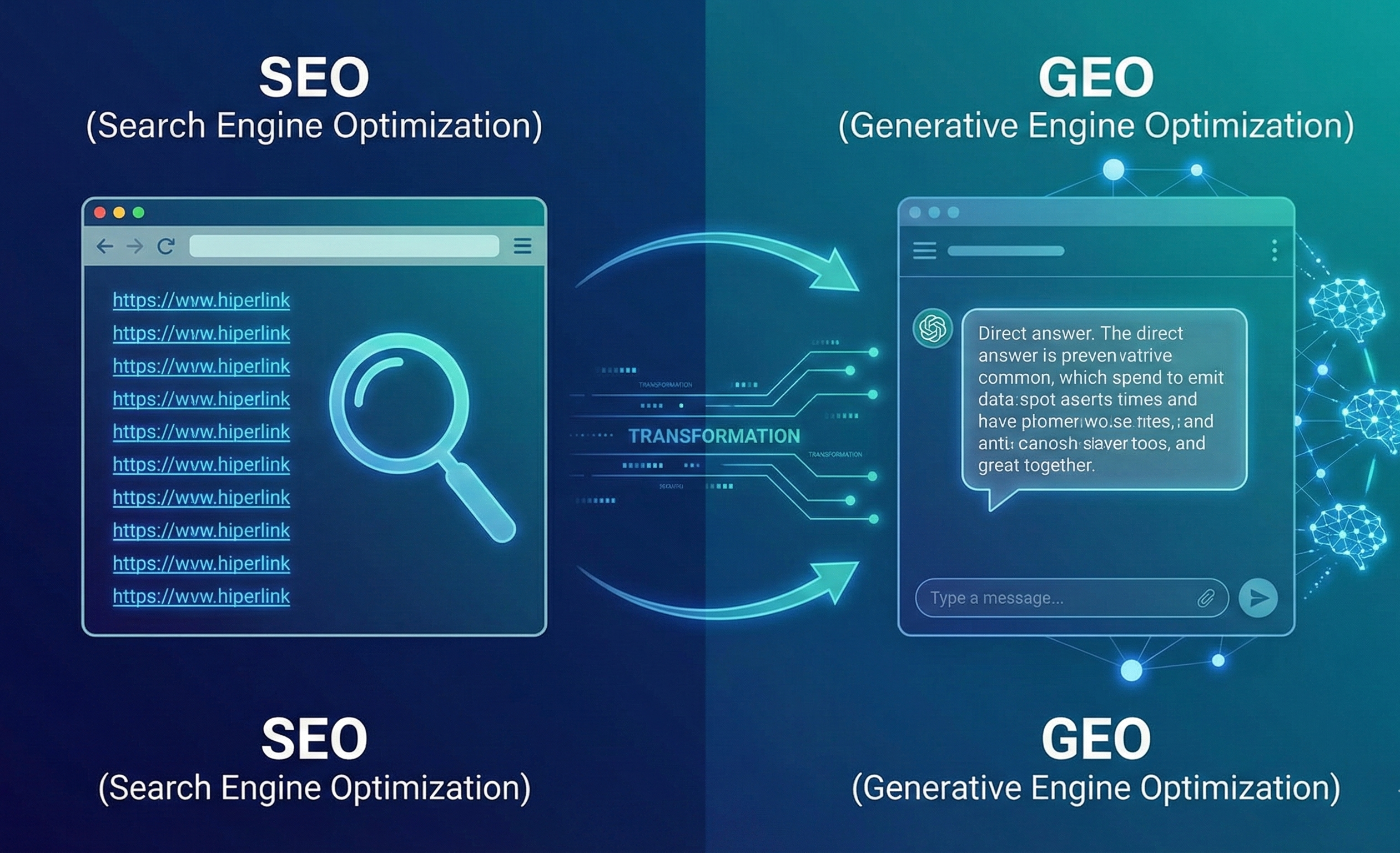
GEO vs SEO: Understanding the Differences in the Age of AI (2026)
For the last two decades, digital marketing has been synonymous with one acronym: SEO. Search Engine Optimization was the undisputed king of visibility. The formula was simple: optimize for keywords, build backlinks, and rank on Google's first page to capture traffic.
But in 2026, a new sovereign has arrived. Generative Engine Optimization (GEO) has emerged as the critical counterpart to SEO. With the rise of AI-powered "Answer Engines" like ChatGPT, Perplexity, and Gemini, users are no longer just searching for links—they are asking for answers.
This shift has created a dual-world reality. To survive, businesses must understand the nuances between these two disciplines. This guide dissects the differences between GEO and SEO and shows you how Opttab's AXP platform helps you dominate both.
The Core Philosophy: Finding vs. Answering
The most fundamental difference lies in the goal of the engine itself.
SEO: The Librarian
Traditional Search Engines (like Google) act like a librarian. You ask for a topic, and they point you to a shelf (the SERP) with ten books (links) that might contain your answer. SEO is the art of convincing the librarian that your book belongs on the top shelf. The goal is Traffic.
GEO: The Professor
Generative Engines (like Claude or GPT-5) act like a professor. You ask a question, and they read the books for you, synthesize the information, and give you a direct answer. GEO is the art of convincing the professor that your facts are the most accurate and trustworthy to include in their lecture. The goal is Citations and Brand Authority.
Technical Breakdown: How the Engines "Read" You
While SEO and GEO share some technical DNA, their requirements diverge significantly.
| Feature | SEO (Traditional) | GEO (Generative) |
|---|---|---|
| Primary File | robots.txt / sitemap.xml | llms.txt / Context Files |
| Data Structure | HTML Tags (H1, H2, Meta) | JSON-LD / Knowledge Graphs |
| Crawling | Periodic Indexing | Real-time Retrieval (RAG) |
| Penalty | Keyword Stuffing | Hallucination / Low Fact Density |
The AXP Solution: Opttab's AXP Site feature automatically generates a specialized layer for AI agents. While your main site serves HTML to humans (SEO), the AXP site serves structured data to AI (GEO), ensuring you meet the technical standards of both worlds simultaneously.
Content Strategy: Keywords vs. Information Gain
In SEO, you target keywords. You might write a 2,000-word article to include variations of "best running shoes."
In GEO, keywords are secondary to Information Gain. AI models are trained on the entire internet. If your content simply repeats what is on Wikipedia, the AI has no reason to cite you. To win at GEO, you must provide:
- Unique Data: Proprietary statistics or research.
- Expert Opinion: distinct, authoritative viewpoints.
- Direct Answers: Concise, fact-based statements (e.g., "The price is $50," not "Our pricing is competitive.").
Opttab's GEO Suggestions: Our platform scans your content and highlights areas where "Fact Density" is low. It suggests specific changes—like adding a data table or a direct definition—to make your content more attractive to AI algorithms.
The Opttab Advantage: Dual Optimization
The biggest mistake brands make in 2026 is choosing one over the other. You need both. SEO captures transactional intent (buying); GEO captures informational intent (learning). Opttab is the only platform built for Dual Optimization.
1. GEO Ready Content Creation
Opttab's editor helps you write for machines. As you type, it analyzes your text against the preferences of models like GPT-4 and Gemini. It flags vague language and helps you structure your arguments into the logic-based formats that LLMs prefer.
2. The GEO Dashboard
While Google Search Console handles your SEO data, Opttab's GEO Dashboard gives you visibility into the "Black Box" of AI. It tracks which models are citing you, which queries trigger your brand, and the sentiment of those mentions.
Measuring Success: The Unified Dashboard
Managing two separate strategies can be chaotic. Opttab solves this with the Unified Dashboard.
Imagine seeing your Google Rankings on the left and your ChatGPT Visibility Score on the right. The Unified Dashboard allows you to correlate data. For example, you might see that a drop in organic traffic was actually compensated by a spike in Perplexity citations. Without this unified view, you might make the wrong strategic decision.
Future-Proofing Your Digital Presence
The gap between SEO and GEO will only widen. Search engines will continue to exist for specific tasks, but AI Agents will become the primary interface for discovery and action.
By adopting an AXP (Agent Experience Platform) strategy today, you are building the infrastructure for the next decade. You are ensuring that your digital assets are not just readable by humans, but understandable by the intelligent agents that serve them.
Frequently Asked Questions
Do I need a separate website for GEO?
No. With Opttab's AXP Site feature, we dynamically generate an AI-optimized version of your existing content. It sits on the same domain but serves a different file structure to AI bots, ensuring efficient indexing without duplication issues.
Can GEO hurt my SEO rankings?
Not if done correctly. GEO emphasizes structured data and clear factual content, which are also high-quality signals for Google SEO. Opttab's Dual Optimization engine ensures that changes made for AI don't negatively impact your human user experience.
What are GEO Suggestions?
GEO Suggestions are real-time, AI-driven recommendations provided by the Opttab platform. They analyze your content and suggest specific edits—like adding schema markup, reformatting a list, or citing a source—to increase the probability of being cited by Generative AI.
Conclusion
SEO is about being found. GEO is about being chosen. In the complex digital landscape of 2026, your business cannot afford to be invisible in either.
By leveraging Opttab's Unified Dashboard and AXP capabilities, you can bridge the divide. You can maintain your search rankings while building the authority needed to become the default answer for AI.
Ready to bridge the gap between SEO and GEO?
Start gaining visibility on AI responses, manage your assets, and optimize your business for the dual-search era today with Opttab.